Flight Itinerary vs Booking vs Reservation: What Embassies Actually Want
If your visa checklist says "flight itinerary" but you're not sure whether that means you need to buy a ticket, you don't. Here's exactly what each term means and what your embassy is actually looking for.
Quick Answer: The Difference at a Glance
| Term | What It Means | Pay Full Fare? | Verified How? | Embassy Accepts? |
|---|---|---|---|---|
| Electronic Itinerary | Document generated from real flight data, hosted on a dedicated portal | No | QR code → reservation portal | ✅ Yes |
| Flight Reservation (PNR-based) | Temporary airline hold with a booking reference | No (not yet) | Airline system — for 24–72 hrs only | ✅ Yes |
| Flight Booking | Confirmed, paid purchase | Yes | E-ticket number, any time | ✅ Yes |
| Confirmed Ticket | Fully paid, e-ticket issued | Yes | E-ticket number, any time | ✅ Yes |
The practical upshot: for most visa applications, an electronic itinerary or a flight reservation is all you need. You do not have to purchase a ticket before your visa is approved.
What Is a Flight Itinerary?
A flight itinerary is a document that sets out your planned travel details, your route, airlines, flight numbers, departure and arrival cities, and travel dates. It's built from real flight data, carries your full name, and gives embassies a clear picture of your intended trip.
The keyword is intended. An itinerary represents your plan, not a financial commitment to a specific seat on a specific aircraft. That distinction is exactly why the Embassy of Spain, and many others, actively recommend that applicants provide a planned itinerary rather than purchasing actual tickets before approval:
"We recommend that you do not purchase travel tickets until your visa has been approved. On the other hand, you may provide us with a reservation, a planned itinerary or an online printout of a round-trip ticket." — Embassy of Spain
When Get Itinerary creates a flight itinerary for you, it's generated from the Amadeus Global Distribution System, along with several other live flight-data services, and the system pulls from whichever responds fastest to keep delivery quick, reflecting real flight numbers, schedules, and routes rather than invented details. The document is then stored on a reservation portal and linked to a QR code, which an embassy can use to verify the details if it chooses to check.
What Is a Flight Reservation?
A flight reservation in the traditional sense is a hold placed directly through an airline's booking system. It generates a Passenger Name Record, a short code tied to a specific seat on a specific flight. No payment has been made yet, but the seat is held under a passenger's name.
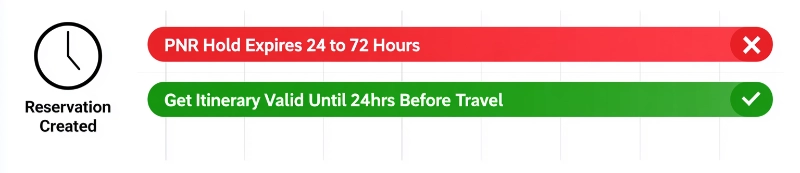
The problem with this approach for visa purposes is timing. Airline holds are temporary, most last between 24 and 72 hours before the reservation is automatically released and the seat goes back to general inventory. That's fine if your visa is processed in a day. It's not fine if your application sits in a queue for two weeks while the hold has long since evaporated.
If a consular officer checks that booking reference after the hold expires, the system simply returns no reservation found. That's not a helpful message to have attached to your application at a critical moment, and it can cast doubt on a document that was perfectly legitimate when it was submitted.
What Is a Flight Booking?
A flight booking is a fully confirmed, paid purchase. You've handed over payment, the airline has issued you an e-ticket, and that seat is yours, subject to the fare's terms and conditions.
Embassies absolutely accept confirmed bookings as proof of travel. The issue is sequencing. If you book before your visa is approved and the application is refused, you're now trying to get a refund on a ticket you can't use, and most fares aren't refundable. The overall Schengen visa refusal rate was 14.6% in 2024, according to European Commission data, and rates vary widely by country, from under 5% in some states to well over 30% in others. That's a real financial risk to take on before you know the outcome.
This is why most people who've been through the visa process more than once get their itinerary sorted first, use it for the application, and purchase the real ticket once approval is confirmed.

What Do Embassies Actually Ask For?
The terminology varies slightly by country, but the substance is consistent.
Schengen Visa (Europe)
The Schengen Visa Code requires proof of onward travel but does not require a paid ticket. A flight itinerary or reservation is standard and widely accepted across all 29 member states, following Romania and Bulgaria's full accession in January 2025. Your document needs to show entry into the first Schengen country you're visiting and an exit from the Schengen area within your intended stay. Dates need to be consistent with your accommodation, insurance, and application form.
UK Standard Visitor Visa
The UK Home Office accepts evidence of travel plans. A flight itinerary qualifies. UK officers tend to read the whole application together, your flights, accommodation, finances, and stated purpose should all align. Inconsistencies between documents draw more scrutiny than the document type itself.
Canada Tourist Visa (TRV)
IRCC accepts travel itineraries as supporting documentation.
Dubai / UAE Visa
A flight itinerary is a standard requirement for UAE visa applications.
Australia Tourist Visa (Subclass 600)
The Department of Home Affairs accepts evidence of travel arrangements; pairing it with accommodation details strengthens the application.
US B1/B2 Visitor Visa
The US doesn't mandate a flight document as formally as Schengen, but including one makes the application considerably more concrete.
Some embassies specifically require a confirmed ticket with a valid PNR rather than an itinerary. Requirements vary and change, check your specific embassy's current guidance before ordering.
What Your Itinerary Document Needs to Include
- Your full name as it appears on your passport - ot a nickname, not an abbreviation, exactly as your travel document reads, including any middle names or hyphens.
- Real airline names and flight numbers - genuine scheduled services on real routes.
- Correct travel dates - entry date, exit date, and all legs of the journey need to align with your other application documents — hotel bookings, travel insurance, and your stated purpose of travel.
- Departure and arrival airport details - both airports should be clearly identified — IATA codes and full city and airport names.
- A Working verification method - a QR code or portal link an officer can actually check, not just a static PDF.
The Timing Problem Nobody Talks About
There's an underappreciated risk with PNR-based flight reservations that's worth being direct about.
Visa processing is not instant. Between submitting your application and receiving a decision, days or weeks can pass. A 24–72 hour airline hold created at the time of submission may have expired long before anyone opens your file.
Get Itinerary's system works differently. Because the itinerary lives on its own reservation portal rather than in an airline's hold queue, it doesn't expire on the airline's schedule. The QR code on the document links to the portal record, which remains accessible right up until 24 hours before the travel date on the itinerary. An embassy checking the document on day one of processing sees the same clean result as one checking it three weeks in, there's no expired reservation and no doubt cast on the document, the verification works every time it's needed.
Is This Legal?
Yes, a planned itinerary submitted as proof of travel intent is an accepted part of the visa application process, not a workaround. It's common enough that embassies, including Spain's, actively recommend it over purchasing a ticket outright. What crosses into fraud is different: inventing flight numbers, generating a booking reference that doesn't resolve to anything real, or editing a genuine document to change names or dates. Consular officers review these daily and are trained to spot it. A legitimate itinerary, built from real flight data and verifiable through a working QR code or portal link, is a fundamentally different document from a fabricated one, even when the two can look similar to an untrained eye.
Common Mistakes That Get Documents Questioned
- Name mismatch - the name on the itinerary must be identical to the name on the passport. A missing middle name or slight spelling difference is enough to prompt questions.
- Date inconsistencies across documents - if your travel insurance runs June 10 to 20, your hotel booking is June 10 to 20, but your flight shows you arriving June 12, someone is going to notice. Every document should tell the same story.
- No return flight - most visa types, particularly Schengen, require a round-trip itinerary showing both entry and exit. An outbound flight alone usually isn't sufficient.
- Using a "generator" instead of a real service - fabricated booking references are treated as document fraud, not a shortcut.
- Ordering too close to your appointment - leave time to fix an error if you catch one.
Need a flight itinerary for your visa application? Order yours here, ready in under 5 minutes, from $15.
Frequently Asked Questions
Is a flight itinerary the same as a dummy ticket?
Yes, generally, "dummy ticket" is the informal term a lot of applicants search for, referring to the same kind of document: a placeholder reservation used for visa purposes rather than a paid ticket. The meaningful difference is in how it's produced.
What happens if I buy a real ticket and my visa is rejected?
It depends on the fare. Non-refundable tickets, the majority of what's sold, mean the money is gone. Some airlines will apply the value as credit toward a future booking, but that's not guaranteed. Refundable fares can be cancelled, but you're working within the refund window and trusting the money comes back promptly. This is the core reason experienced travellers and visa consultants consistently advise against purchasing tickets before visa approval.
Can I use a screenshot of a flight search as my itinerary?
No. A search result from Google Flights or Skyscanner shows what flights exist, it doesn't show that you have any kind of reservation on any of them. There's no passenger name, no booking reference, and nothing that connects that search to your application. Embassy staff sees this regularly, and it doesn't satisfy the requirement. You need a proper travel document with your name, travel details, and a verification method.